

Create the Perfect Indoor Outdoor Space with The Floor Store
Here in the Bay Area, we are blessed with a climate that practically begs us to open up our homes. Whether you are enjoying a sunny afternoon in San Jose, a breezy evening in San Rafael, or a clear day looking out over the hills in Walnut Creek, blurring the lines between our indoor spaces and our outdoor patios is the ultimate design goal.
When you install large folding glass walls or massive sliding doors, you visually double your living space. But to make that transition truly feel seamless, your flooring choices have to work together. If your indoor floor clashes completely with your outdoor deck or patio, the illusion is broken.
Achieving a flawless indoor-outdoor flow requires balancing beautiful aesthetics with materials that can handle the elements. Explore these top indoor outdoor flooring strategies to create an unbroken connection to the outdoors.
Table of Contents
- Best Indoor Outdoor Flooring Options for a Seamless Look in Your Bay Area Home
- Porcelain Tile: The Ultimate Mirror Image
- Luxury Vinyl Plank (LVP) Paired with Matching Composite Decking
- Play with Plank Orientation and Threshold Heights
- Create Your Dream Space with Flooring that Holds Up Year Round!
- Indoor Outdoor Flooring Frequently Asked Questions
Best Indoor Outdoor Flooring Options for a Seamless Look in Your Bay Area Home
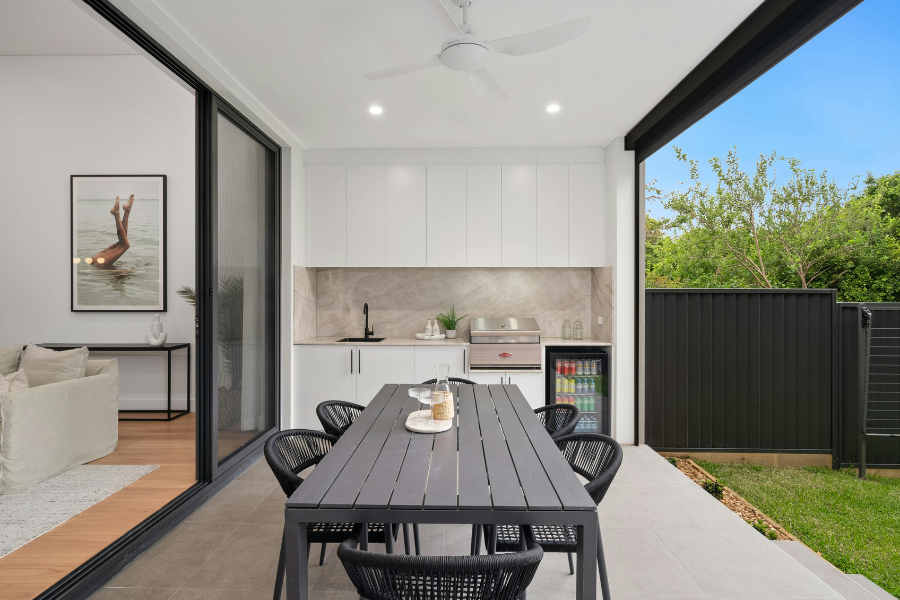
Porcelain Tile: The Ultimate Mirror Image
If you want a truly matching, continuous floor that runs straight from your kitchen or living room right out onto the patio, porcelain tile is the gold standard.
Because porcelain is incredibly dense and fired at extremely high temperatures, it absorbs almost no moisture. This makes it completely frost-proof and sun-resistant, meaning it won’t fade or crack under the California sun or during a chilly North Bay winter night.
- The Inside-Out Strategy: Many premium tile manufacturers now create “sister” collections. You can choose a smooth, polished, or matte finish porcelain stone look for your indoor living room, and the exact same colorway with a textured, slip-resistant grip finish for the outdoor patio. The visual sightline remains completely uninterrupted, but you stay safe when walking outside after a pool day or a rainy morning.
Luxury Vinyl Plank (LVP) Paired with Matching Composite Decking
Many Bay Area homeowners love the warmth of natural wood indoors but recognize that running true hardwood right up to an outdoor threshold can be risky due to moisture tracking and sun fading.
A brilliant alternative is utilizing a premium, rigid-core luxury vinyl plank (LVP) inside, and transitioning to a high-end composite decking outside that mirrors the same tone and plank width.
Modern LVP is highly stain-resistant and easily stands up to the heavy foot traffic, wet feet, and paws traveling in and out of the house. By choosing an LVP with a realistic white oak or warm sandy tone and matching it to a similar shade of weather-resistant composite decking, you get the look of a continuous wood floor without the high-maintenance upkeep.
Play with Plank Orientation and Threshold Heights
To make the transition feel completely natural, pay close attention to the direction your flooring runs.
Whenever possible, install your wood planks, LVP, or rectangular tiles so they run perpendicular to the outdoor opening. This draws the eye straight through the glass and out into the yard, making both spaces feel substantially larger.
Additionally, work with your installer to keep the subfloor heights as flush as possible. Minimizing the height of the transition track or threshold lip makes the physical transition smooth and safe for kids, guests, and pets.
A Quick Guide to Maintenance: Indoor-outdoor layouts naturally mean more dust, pollen, and debris will make its way inside. Choosing flooring materials that are easy to sweep, damp-mop, and resist scratching from tracked-in grit ensures your open-concept layout remains a joy to live in rather than a chore to clean.
Create Your Dream Space with Flooring that Holds Up Year Round!
Creating a perfect indoor-outdoor flow is highly visual, and the best way to ensure your indoor flooring perfectly complements your outdoor vision is to see the products side-by-side. At The Floor Store, our knowledgeable showroom teams are experts at matching textures, explaining performance ratings, and helping you find the perfect materials that fit your style, lifestyle, and budget.
We invite you to visit one of our 10 convenient showrooms across the Bay Area to explore our massive selection of indoor tiles, luxury vinyls, hardwoods, and countertops:
- North Bay: San Rafael, Santa Rosa
- East Bay: Concord, Dublin, Fairfield, Richmond/Albany
- The Peninsula & South Bay: San Carlos, San Francisco, San Jose, Sunnyvale
Indoor Outdoor Flooring Frequently Asked Questions
Q: Can I use standard indoor porcelain tile out on my patio?
We strongly advise against using a tile rated strictly for indoors on an outdoor space. Indoor tiles often feature smooth or glazed surfaces that become incredibly slick and dangerous when exposed to morning dew, rain, or pool water.
Always look for tiles explicitly rated for outdoor use, which feature a higher slip-resistance rating (often measured as DCOF, or Dynamic Coefficient of Friction) to ensure proper traction.
Q: How do I protect my indoor flooring near the outdoor doors from sun damage?
Large glass doors let in beautiful natural light, but intense UV rays can cause certain materials to fade or discolor over time.
To protect your investment, look for premium luxury vinyl flooring with enhanced UV-inhibiting wear layers. Additionally, investing in high-quality low-E glass for your sliding doors or utilizing stylish sheer curtains during peak afternoon sun will drastically extend the life and color vibrancy of your indoor floors.
Q: Is natural stone like travertine a good option for an indoor-outdoor look?
Natural stone like travertine, slate, or limestone looks absolutely stunning and naturally bridges the gap between indoors and out.
However, stone is inherently porous. If you choose natural stone, it must be properly sealed upon installation—and periodically resealed over time—to protect it from food spills indoors and organic stains (like leaves or dirt) outdoors. For a lower-maintenance alternative that looks identical, many clients opt for stone-look porcelain tile instead.